
THE SUPERB AND UNEXPECTED ON EVERY PAGE

STAY CONNECTED


WEALTH
BEYOND
THE
GARAGE
As wealth increasingly shifts toward
passion-driven assets, collector-focused
real estate is creating a new intersection of
investment, lifestyle, and community.
REGINA RUSSO
.jpg)
.jpg)
For generations, luxury real estate has served as one of the defining pillars of wealth preservation. From oceanfront estates in Palm Beach and seasonal compounds in the Hamptons to penthouses overlooking Manhattan and mountain retreats in Aspen, prime property has long represented far more than shelter. It has functioned as a store of value, a symbol of achievement, and often a family’s most significant asset.
Yet as wealth evolves, so do the environments that support it.
.jpg)
.jpg)
Today’s affluent investors increasingly allocate capital beyond traditional asset classes, building collections that include rare automobiles, fine art, vintage wines, watches, memorabilia, and other passion-driven acquisitions. These assets are no longer viewed simply as indulgences. For many collectors, they represent meaningful components of a diversified portfolio.
The question increasingly confronting collectors is not simply what to acquire, but where those assets belong.
That challenge has helped give rise to an emerging category of real estate designed specifically around the preservation, enjoyment, and display of alternative assets. At the forefront of that movement is The Hangar Group, whose sold-out developments in Riviera Beach and Palm Beach have attracted collectors seeking something beyond traditional storage.
“For investors who are already allocating significant capital to assets, whether cars, art, or wine, this becomes the environment in which those assets live, are preserved, and are enjoyed,” says Scott Cunningham, Founder and CEO of The Hangar Group. “It serves a role in protecting those collections while also operating as an appreciating real estate position in high-demand markets with limited supply.”
The implications extend well beyond storage.
Rather than treating collections as possessions that reside in garages, warehouses, or off-site facilities, The Hangar positions them within purpose-built environments designed around ownership itself. The result is a category that combines elements of luxury real estate, alternative assets, private club culture, and experiential living.
.jpg)
.jpg)
A Home Worthy of the Collection
The rise of alternative assets has become one of the defining wealth trends of the past decade. Yet while collectors have become increasingly sophisticated in what they acquire, the environments available to house those collections have often remained surprisingly limited.
“What we have seen is a gap between what people collect and the environments available to support those collections,” Cunningham explains. “A collection of cars, art, or wine requires conditions that most homes cannot provide, and traditional storage does not match the quality or sensibility of what is being stored.”
The idea for The Hangar emerged from Cunningham’s own experience as a collector.
.jpg)
.jpg)
“We started The Hangar Group because that gap was visible to me as a collector before it was visible as a business. After buying my first Ferrari, I wanted to give it a home worthy of its beauty.”
That realization eventually evolved into a business model that would attract collectors throughout South Florida and beyond. The Hangar’s Palm Beach International Airport location officially sold out within six months of completion, while inquiries continue to arrive despite the absence of available inventory.
The demand reflects a broader shift among affluent buyers who increasingly seek environments that allow them to enjoy their assets rather than simply store them.
.jpg)
.jpg)
.jpg)
Beyond Storage
The distinction between The Hangar and conventional storage facilities extends far beyond architecture and security.
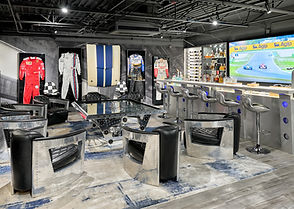
Each privately owned unit is delivered as a blank canvas, allowing owners to customize the space around their individual passions. Some become automotive galleries showcasing rare Ferraris, Lamborghinis, Porsches, and vintage classics. Others evolve into sophisticated entertaining environments complete with wine collections, art installations, executive lounges, private offices, and hospitality-focused gathering spaces.
“There are practical limitations, and there are experiential ones,” Cunningham says. “On the practical side, most homes cannot accommodate the scale, security, or climate requirements that collections of this caliber demand.”
Every Hangar features superior construction, individually controlled temperature and humidity systems, generous ceiling heights, hurricane-rated motorized garage doors, advanced security, private restrooms, and optional mezzanine expansions.
Yet the experiential component may be the most compelling.
“A collection sitting in a residential garage or a remote storage facility rarely gets used or shared,” Cunningham explains. “At The Hangar, owners are designing their hangars as galleries, lounges, and entertaining environments. Combined with the ownership amenities and the community, the collection becomes part of how owners live and host.”
The evolution mirrors broader trends throughout the luxury landscape.
“It is very much part of that shift,” says Cunningham. “Private aviation is one example. The category has moved toward fractional ownership and membership models that prioritize convenience and community. The Hangar reflects the same evolution.”
Like many modern luxury categories, value increasingly extends beyond the physical asset itself. What owners ultimately seek is a combination of access, experience, personalization, and connection.
.jpg)
The Value of Personalization
Customization sits at the center of The Hangar model.
“It is central,” Cunningham says. “Owners want a space that reflects who they are and what they collect, and the customization is what makes that possible.”
Many owners utilize mezzanine expansions to create elevated viewing platforms overlooking their collections. Others incorporate museum-quality lighting, custom millwork, wine rooms, entertainment areas, and hospitality spaces designed for hosting friends, clients, and fellow enthusiasts.
“That investment creates an emotional connection to the hangar, which in turn supports long-term value,” Cunningham says. “When owners design a space that genuinely reflects them, they hold it longer.”
The result is a highly individualized ownership experience where no two spaces are alike.
“That transition usually happens during the design phase,” Cunningham explains. “Owners begin thinking about lighting, finishes, layout, and how the collection will be experienced rather than just how it will be stored.”
.jpg)
.jpg)
.jpg)
.jpg)
The Club Effect
While the physical spaces attract initial interest, the community often becomes the defining element of ownership.
“It is one of the most important parts of the decision,” Cunningham says. “The hangar itself is what brings people through the door, but the community is what makes them want to stay.”
With locations now operating in West Palm Beach and Riviera Beach, and a forthcoming Hamptons destination scheduled to break ground in Fall 2026 and open in 2027, The Hangar combines the privacy and security of ownership with the atmosphere of a private members’ club.
Owners receive equity membership and access to exclusive amenities including Owners’ Lounges, executive boardrooms, golf and driving simulators, rooftop sunset decks, concierge-supported services, and a growing network of fellow collectors.
“When a prospective owner sees how the Owners Lounge functions, how the rooftop becomes a gathering space, and how owners interact with one another, the attraction is both personal and emotional and goes well beyond a simple real estate purchase.”
That community extends beyond the properties themselves through The Collective, a curated calendar of experiences designed around shared passions.
Signature events include private rallies, owner-hosted gatherings, curated social events, and the annual Hangar Crawl, where members open their hangar doors and invite fellow owners to explore their collections and personal spaces.
Owners also participate in international experiences that blur the lines between club membership, luxury travel, and collector culture.
The upcoming Dolomites Grand Tour will take participants through more than 350 kilometers of northern Italy’s most celebrated mountain roads behind the wheel of Ferraris, Lamborghinis, and Porsches. The route traverses iconic alpine passes including Passo Sella, Passo Pordoi, Passo Falzarego, and Passo Giau, complemented by Michelin-starred dining and luxury accommodations.
Additional experiences have included attendance at the Monaco Grand Prix aboard a superyacht through relationships with Ferrari and Canossa.
“The community is one of the most valuable parts of ownership,” Cunningham says. “The hangar is the foundation, but it is the network of fellow collectors and the experiences we build around them that extend ownership beyond that.”
.jpg)
Scarcity and Appreciation
From an investment perspective, The Hangar occupies a unique position.
The Palm Beach International Airport location has achieved the highest price-per-square-foot valuation in the United States for privately owned garage space, reflecting a combination of location, quality, scarcity, and demand.
“Pricing in this category reflects what does not exist elsewhere,” Cunningham explains. “Several factors drove that valuation. One is location. Palm Beach is among the most sought-after luxury real estate markets in the country. Another is the quality of the hangar itself.”
Scarcity remains central to the company’s philosophy.
“Each location is sized to support a community, not maximize hangar count,” Cunningham says. “Once a location is sold out, it is sold out.”
That approach has already begun producing a noteworthy secondary market.
“The hangars are fee-simple condominiums and can be resold,” he says. “Most buyers purchase with no intention of selling, but on the rare occasion that resales do occur, they have consistently closed at substantially above the original purchase price.”
Those dynamics have become increasingly attractive as affluent buyers seek tangible assets supported by scarcity, location, and lifestyle utility.
The Next Evolution of Wealth
Following successful sellouts in Riviera Beach and Palm Beach, The Hangar’s next chapter is already underway.
The company’s forthcoming Hamptons development will initially offer ownership on an invitation-only basis, followed by limited waitlist opportunities. Owners will enjoy reciprocal privileges across current and future Hangar locations, creating a growing network designed around the seasonal movement patterns of affluent collectors.
“Many of our owners move between seasonal markets,” Cunningham explains. “Additional locations in places they already spend time keep them within the same community wherever they are.”
The vision extends well beyond automotive enthusiasts alone.
“Our owners are not exclusively automotive collectors,” Cunningham says. “They are storing and showcasing fine art, wine, memorabilia, and other assets. What unites these collections is not the asset type but the way owners want to interact with them.”
Traditional luxury real estate has long defined where wealth lives. Increasingly, however, affluent collectors are seeking environments designed around the assets, passions, and experiences that define how they live. As alternative assets continue to grow in prominence and experiential ownership reshapes luxury markets, collector real estate appears positioned to occupy a category all its own.
As Cunningham observes, “The Hangar represents the parallel environment that has not previously existed at this caliber. It is where the collection lives, where the passion is expressed, and where the community forms.”