
THE SUPERB AND UNEXPECTED ON EVERY PAGE

STAY CONNECTED


WEALTH
WHERE THE NEXT FORTUNES ARE BEING MADE
The world’s ultra-wealthy population is expanding at remarkable speed. America remains the dominant engine of private wealth, but some of the fastest growth is now appearing in economies that sat well outside the traditional centers of capital only a generation ago.
MICHAEL SPEED
Over the past five years, the world has added more than 162,000 people worth at least $30 million. Put another way, an average of 89 people crossed that threshold every day between 2021 and 2026. According to Knight Frank’s The Wealth Report 2026, the global ultrahigh-net-worth population increased from 551,435 to 713,626 during that period, an extraordinary expansion occurring despite inflation, geopolitical uncertainty and repeated disruption to financial markets. Wealth may be moving more freely around the world, but just as important is the speed at which entirely new fortunes continue to be created.
For all the attention paid to emerging markets, the United States remains the most powerful wealth-creation engine in the world. Forty-one percent of all newly minted UHNWIs over the past five years were created in the U.S., increasing the country’s share of the global population from 33% in 2021 to 35% in 2026. Knight Frank expects that concentration to strengthen further, with the U.S. potentially accounting for 41% of the world’s $30 million-plus population by 2031. China remains the second major center, although its share of the global total is projected to decline from 17% today to 15% by the end of the forecast period.
America’s advantage lies less in any single industry than in the breadth of the system supporting wealth creation. Its deep public markets sit alongside private equity, venture capital and an established financial sector, while technology continues to produce and recycle enormous pools of capital. Knight Frank points specifically to AI, biotech and deep tech as important multipliers. Combined with a large domestic market, sophisticated legal and financial infrastructure and access to capital, the result is an economy capable of producing wealth repeatedly and at enormous scale. The U.S. alone is forecast to add more than 136,000 UHNWIs during the next five years.
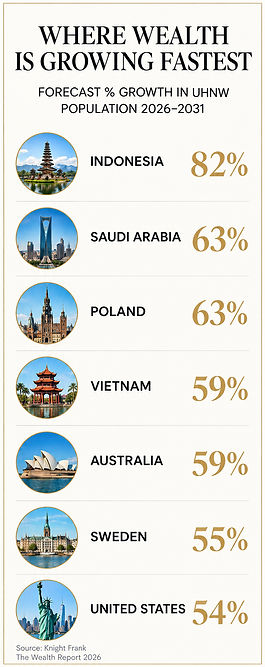
Scale, however, is only one way to read the numbers. Look instead at percentage growth and a very different map appears. Indonesia leads Knight Frank’s forecast, with its $30 million-plus population expected to rise 82% between 2026 and 2031. Saudi Arabia and Poland follow at 63%, Vietnam and Australia at roughly 59%, and Sweden at 55%. The United States, despite its much larger base, is still expected to grow by 54%. The figures suggest that wealth is broadening geographically even as the largest concentrations of capital continue to strengthen.
Today’s affluent investors increasingly allocate capital beyond traditional asset classes, building collections that include rare automobiles, fine art, vintage wines, watches, memorabilia, and other passion-driven acquisitions. These assets are no longer viewed simply as indulgences. For many collectors, they represent meaningful components of a diversified portfolio.
The question increasingly confronting collectors is not simply what to acquire, but where those assets belong.
That challenge has helped give rise to an emerging category of real estate designed specifically around the preservation, enjoyment, and display of alternative assets. At the forefront of that movement is The Hangar Group, whose sold-out developments in Riviera Beach and Palm Beach have attracted collectors seeking something beyond traditional storage.
“For investors who are already allocating significant capital to assets, whether cars, art, or wine, this becomes the environment in which those assets live, are preserved, and are enjoyed,” says Scott Cunningham, Founder and CEO of The Hangar Group. “It serves a role in protecting those collections while also operating as an appreciating real estate position in high-demand markets with limited supply.”
The implications extend well beyond storage.
Rather than treating collections as possessions that reside in garages, warehouses, or off-site facilities, The Hangar positions them within purpose-built environments designed around ownership itself. The result is a category that combines elements of luxury real estate, alternative assets, private club culture, and experiential living.
What makes these emerging markets interesting is that they represent more than the migration of wealthy people toward favorable tax regimes or attractive lifestyles. They point toward economies developing a greater capacity to produce wealth domestically. Vietnam’s projected rise, for example, helps illustrate the formation of new wealth centers across Southeast Asia, while Poland and Sweden show that the trend is hardly confined to the developing world. Knight Frank describes the next stage of global wealth growth as being led in percentage terms by rapidly maturing economies rather than simply the traditional financial capitals.
Australia offers one of the clearest examples of how that process can unfold. Its ultra-high-net-worth population is forecast to rise by almost 60% over the next five years to 26,095, a figure equivalent to nearly one person in every thousand residents. Its wealth base remains supported by agriculture and mining, but finance, business services and an increasingly mature technology sector are becoming more important contributors. Knight Frank also forecasts a 77% increase in Australia’s billionaire population between 2026 and 2031, suggesting that the country’s wealth story is becoming both deeper and more diverse.
India provides a different example. Its $30 million-plus population grew 63% between 2021 and 2026, increasing from just over 12,000 individuals to nearly 20,000. Technology, industrials and capital markets have all contributed, but the more important development may be the financial ecosystem forming around that wealth. Knight Frank points to deeper pools of capital, increasingly sophisticated financial markets, digitalisation, listed equities, private capital and family-owned businesses. Growth is expected to moderate to 27% over the next five years, taking the total beyond 25,000, but the underlying base of wealth is becoming more durable and more globally connected.
The regional picture is equally revealing. North America currently accounts for 37% of the global ultra-high-net-worth population and is projected to reach 43% by 2031. Asia-Pacific represents almost 31% today, with its population forecast to increase from 219,310 to 272,530 over the same period, while Europe remains home to more than 183,000 very wealthy individuals. The result is not a simple transfer of financial power from West to East, or from established economies to emerging ones. Instead, wealth creation is becoming more geographically varied while remaining highly concentrated in a relatively small number of exceptionally productive markets.
For investors, that distinction matters. The places where wealthy individuals choose to live can shift quickly in response to tax, regulation and lifestyle, but the places capable of creating wealth reveal something more structural about an economy. They point to entrepreneurship, access to capital, expanding industries and the ability to turn business growth into private fortunes. Today’s founders and business owners become tomorrow’s private investors, family capital and institutional partners, influencing everything from private equity and venture investment to philanthropy and luxury consumption. The next generation of global capital is already being formed, and understanding where it originates may prove far more useful than simply tracking where it eventually choosesto reside.